How to Distinguish an Overseas Brand’s Official Store From a Shopping Site That Copies Its Name and Design
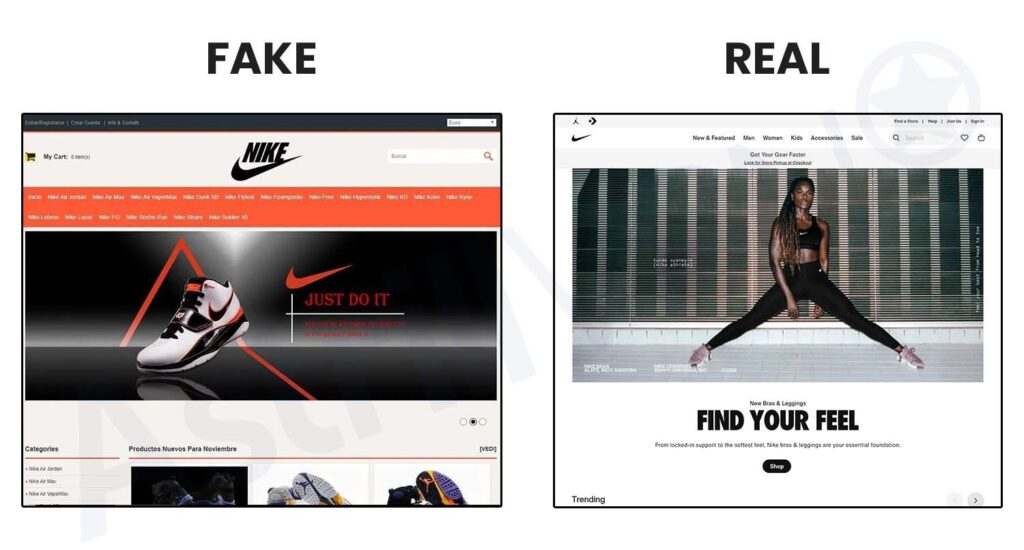
Purchasing goods from international brands through online webstores is a common habit for global consumers. However, alongside the growth of cross-border e-commerce, sophisticated online fraud schemes have also increased significantly. Bad actors frequently set up copycat webstores that clone the complete interface, product photography, typography, and even domain structures of famous fashion, technology, or cosmetics brands to steal financial assets or deliver counterfeit goods.
To avoid falling into the trap of fraudulent websites, shoppers need to equip themselves with verification techniques based on technical standards, legal transparency, and independent fact-checking workflows.
The Nature of Copycat Websites Impersonating Overseas Brands
A copycat website is not merely an unauthorized third-party reseller or an gray-market importer. These systems are deliberately engineered to visually deceive visitors.
Scammers often run targeted advertisements on search engines or social media platforms featuring irresistible headlines such as “80% Off Warehousing Clearance” or “End of Season Special Sale.” When users click these ads, they are redirected to a storefront that visually mirrors the brand’s official site. If buyers fail to inspect the web address bar closely, they can easily enter their credit card numbers, delivery addresses, and complete transactions with a fraudulent organization.
5 Key Signs and Technical Methods to Identify Official Stores
1. Analyzing Domain Structure, Domain Age, and WHOIS Data
The domain name serves as the primary indicator for determining the legitimacy of a website.
- Deliberately Confusing Domain Variations: Copycat websites rarely secure a brand’s original root domain. Instead, they attach extra terms like
outlet,sale,official,store,vip,discount, or substitute standard top-level domains like.comwith.shop,.top,.vip, or.site. For example, while the authentic brand usesbrand.com, a fraudulent site might operate underbrand-official-outlet.shop. - Checking Domain Age (WHOIS Lookup): A major international brand operating for decades will not host its official webstore on a domain registered just a few weeks or months ago. Shoppers can use free WHOIS lookup tools to verify a domain’s creation date. If a website claims to be an authorized flagship store of a global brand but its domain was registered within the last 30 to 60 days, it is a clear indicator of a scam.
2. Unrealistically Low Prices and Fake Clearance Tactics
Price tags are the most common bait deployed by copycat websites.
Premium international brands maintain strict price control policies. They rarely offer site-wide discounts ranging from 70% to 90%. If you land on a webstore where every single catalog item from the latest seasonal collection to classic flagship products is heavily discounted, raise immediate doubts.
In addition, copycat sites heavily rely on dark patterns, such as fake countdown timers claiming discounts expire in minutes, or simulated notifications like “Customer A just purchased Product B,” designed to induce artificial urgency and push shoppers into impulsive decisions.
3. Cross-Referencing Retailer Directories on the Official Website (Store Locator)
The most definitive method of verification is to ignore self-proclaimed promotional claims on the site itself.
Proactively navigate to the brand’s primary global website (the original official domain) and locate pages such as “Store Locator”, “Where to Buy”, or “Authorized Retailers”.
All legitimate distribution partners, regional online storefronts, and authorized retail channels are publicly indexed there by the manufacturer. If the web address you are evaluating is not listed in this official directory, it is not an official store.
4. Checking Social Media Links and Integrated Payment Gateways
The gap between a professionally maintained e-commerce site and a hastily constructed phishing page is visible through technical integration features:
- Dead Social Media Links: Copycat sites regularly place Facebook, Instagram, and YouTube icons in the footer to mimic legitimacy. However, clicking these icons often yields no response, redirects back to the social media platform’s generic homepage, or leads to an unrelated personal profile. Official brand sites direct users straight to verified (blue-check) social media handles.
- Irregular Payment Methods: Official webstores integrate established international payment gateways (Visa, Mastercard, PayPal, Apple Pay) with standard SSL encryption. Copycat websites frequently request direct bank wire transfers, cryptocurrency payments, or redirect to unfamiliar domain names during the payment phase that do not belong to bank networks.
5. Corporate Legal Transparency and Warranty Terms
A legally operating enterprise publicly displays its corporate identification details in the website footer or on the “Contact Us” page:
- Physical Address and Contact Information: Authentic stores state their physical office location, business identification/tax numbers, and customer support hotlines. Fake websites usually rely on an anonymous contact form or a generic free email address (e.g., Gmail or Yahoo).
- Return and Warranty Policies: Policies on official sites are detailed and compliant with local consumer protection laws and global brand guidelines. Copycat sites often copy generic template paragraphs filled with grammatical errors, or specify return shipping addresses in a country entirely different from the brand’s actual headquarters.
4-Step Verification Workflow Before Making a Payment
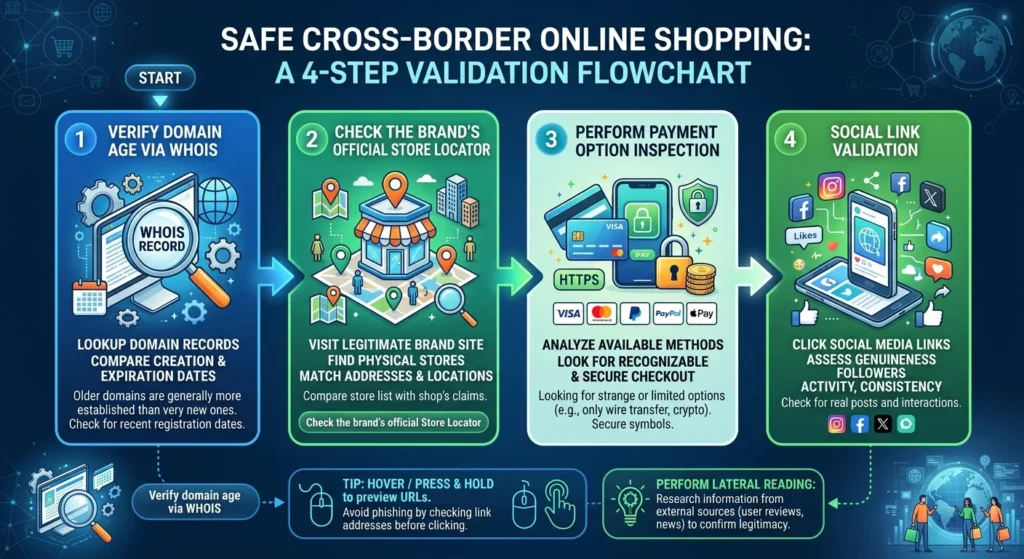
To ensure maximum security when purchasing products from overseas brands, follow this 4-step workflow:
- Hover / Press & Hold to preview URLs: Before clicking any advertisement or shared link, hover your cursor over the link on a desktop or press and hold on mobile to inspect the actual destination URL displayed at the bottom of your screen.
- Verify domain age via WHOIS: Open a new browser tab and use a WHOIS lookup tool to check the domain registration date. Disregard the site immediately if the domain was created recently.
- Check the brand’s official Store Locator: Go directly to the brand’s primary global domain to check if the online store is listed as an authorized retail location.
- Perform Lateral Reading: Open a new tab and search for:
[Website Name] + reviewor[Website Name] + scam. Review feedback on cybersecurity forums and consumer defense communities before entering payment details.
[IMAGE PLACEHOLDER | Search Keywords: verifying official brand online store 4 step checklist flowchart | AI Brief: A professional 4-step flowchart illustrating domain age checking via WHOIS, store locator cross-referencing, payment option inspection, and social link validation for cross-border online shopping. | Alt Text: 4-step flowchart for verifying official international brand webstores]
Frequently Asked Questions (FAQ)
Can a copycat website feature an HTTPS padlock icon?
Yes. An HTTPS padlock icon only confirms that data transmitted between your browser and the web server is encrypted; it does not prove who owns the website. Scammers can easily install free SSL certificates for fraudulent webstores within minutes.
How can I verify whether an international website is an authorized reseller?
The most effective method is to navigate to the brand’s primary global website, locate the “Store Locator” or “Authorized Retailers” section, and search for the domain or store name. Alternatively, you can email the brand’s official customer support team directly for confirmation.
Is a website offering 70-80% off all products from a major brand trustworthy?
Almost certainly not. Major brands exercise tight pricing control to preserve brand equity. Site-wide discounts over 70% across all products (including newly arrived items) are a hallmark sign of scam websites or counterfeit distribution.
What should I do immediately if I inadvertently paid on a copycat store?
If you paid using a credit or debit card, contact your card issuer immediately to request an emergency card freeze and file a fraudulent transaction claim (chargeback). If you entered account passwords, change your password across all services sharing that credential right away.