Evaluating a Contributor Through User Flairs, Reputation Scores, and Account Age
In online communities, technical forums, and social platforms, determining the credibility of a contributor is essential to avoid relying on misleading advice. Rather than trusting intuition, discerning users rely on three publicly visible profile signals: User Flairs, Reputation Scores, and Account Age. This article breaks down the technical nature of each signal, how to combine them into a practical evaluation matrix, and common red flags to watch out for.
Three Core Signals for Evaluating Contributor Credibility
Each profile indicator reflects a different dimension of a user’s activity history and level of community contribution.
User Flairs: Identification Badges and Community Verification Levels
User Flairs are labels displayed next to an account’s username, assigned either by moderators or automated platform systems. There are two primary categories of flairs:
- Self-Assigned Flairs: Selected by users to indicate personal interests, geographic location, or personal perspectives. These hold low evidentiary value regarding domain expertise.
- Mod-Verified / System Flairs: Granted after users submit proof of credentials (such as degrees, certifications, “Top Contributor” designations, or verified developer status). Badges like “Verified Developer,” “Medical Professional,” or “Community MVP” carry significant authoritative weight.

Reputation Scores (Karma / Rep Points): Contribution Metrics and Real Limitations
Reputation Scores (or Karma on Reddit, Rep Points on Stack Overflow) are quantitative metrics tracking positive community interactions (upvotes, accepted answers, helpful comments) accumulated over time.
- Advantages: Demonstrates a history of active participation and community endorsement.
- Limitations: High scores do not guarantee comprehensive expertise. A user can accumulate tens of thousands of Karma points by posting memes or casual commentary in entertainment hubs while lacking technical accuracy in financial or programming topics.
Account Age: Indicators of Stability and Historical Footprint
Account Age indicates how long a profile has existed on a platform:
- Established Accounts (2 to 5+ years): Usually familiar with community guidelines and tend to protect their reputation by providing quality contributions.
- New Accounts (Under 30 days): Require closer scrutiny. However, a new account does not inherently signal fraud or ignorance; it could belong to an industry expert using an alternate profile (alt account) for privacy reasons.
Evaluation Matrix: Combining the 3 Signals
To ensure accurate assessment, avoid evaluating signals in isolation. Instead, cross-reference them within a comprehensive matrix:
| Credibility Tier | User Flair | Reputation Score | Account Age | Recommended Action |
|---|---|---|---|---|
| S-Tier (Very High) | Verified / Top Contributor | High (Accumulated from deep technical posts) | > 2 years | Trust information; suitable for direct reference. |
| A-Tier (High) | None or Self-Assigned | High (Distributed evenly across relevant topics) | > 1 year | Accept information; perform basic verification of cited sources. |
| B-Tier (Moderate) | None | Moderate / Newly active | > 3 years (Sporadic activity) | Cross-check with other community posts. |
| C-Tier (Caution) | None | Very low or sudden spike | < 30 days | Use purely for reference; verify only if external links or hard proof are attached. |
4-Step Practical Verification Process for Contributors
When evaluating critical advice or deep technical analysis, apply this 4-step workflow:
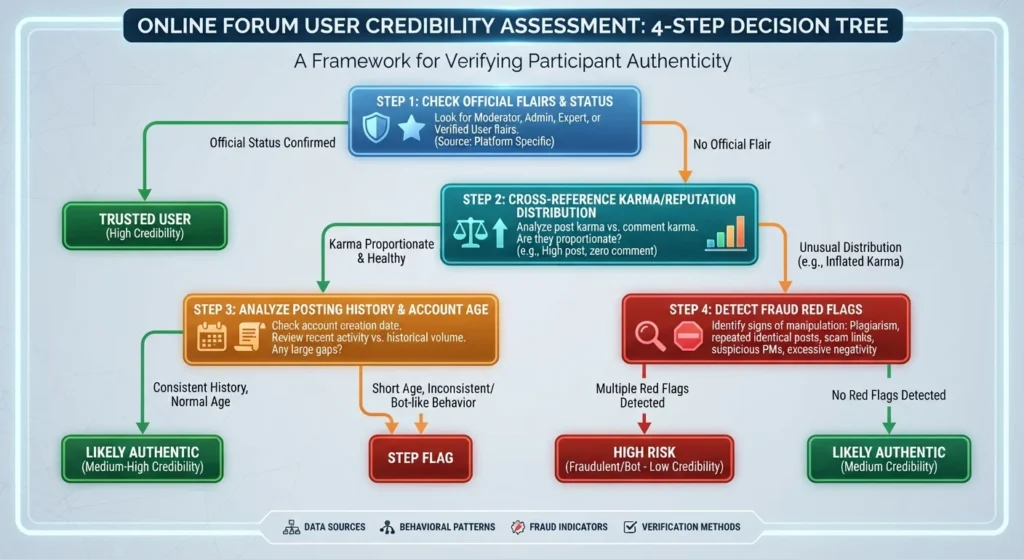
Step 1: Verify Flair Authenticity
Observe whether the user’s flair is self-selected or mod-assigned. If it features official verification icons (dashes, moderator colors, system badges), their input carries substantial weight.
Step 2: Analyze Reputation Score Distribution Across Domains
Click into the profile to analyze where karma was earned. Points accumulated within the specific subreddit or technical category hold far greater value than generic karma earned in casual discussion hubs.
Step 3: Cross-Reference Account Age with Posting Frequency
Evaluate the ratio between account age and activity volume. An account created 5 years ago with only 2 total posts represents a completely different risk profile than a 5-year account posting weekly.
Step 4: Audit Post History and Source Citation
Review their 3 to 5 most recent posts. A reputable contributor maintains consistent tone, logical reasoning, and proactively attaches verifiable citations (research links, official docs, proof screenshots).
Common Red Flags When Auditing Profiles
Bad actors frequently exploit gamified scoring mechanics to manufacture false authority for spam, scams, or manipulation. Watch out for these warning signs:
- Dormant Accounts Suddenly Re-activated: Accounts created 4–5 years ago with zero history that suddenly post high-volume promotional or sensitive advice. This often indicates purchased accounts.
- Karma Farming: Newer accounts posting hundreds of short, low-effort comments or copying top answers across major subreddits to quickly pad reputation numbers.
- Inconsistent Persona and Tone: Claiming to be a “10-year senior physician” in one thread while identifying as a “first-year university student” in another.
FAQ
1. Can I trust an account with high Karma/Reputation created only a few months ago?
Audit their post history carefully. A sudden score surge can result from a single viral meme or automated karma farming. Evaluate the technical substance of their domain-specific posts before trusting their advice.
2. How do I distinguish between an authentic aged account and a purchased dormant account?
Legitimate aged accounts show steady, scattered activity over time. Purchased dormant accounts exhibit multi-year activity gaps followed by an abrupt surge in commercial, promotional, or opinionated posts.
3. How should I evaluate information if a contributor lacks a Verified Flair?
Fall back on core content evaluation: assess logical arguments, data accuracy, and cited documentation within the post itself. A verified flair is a helpful bonus, but verifiable evidence is the ultimate decider.
4. How should I approach detailed advice from a user with no flair and low reputation?
Do not dismiss them outright. Subject matter experts often lurk or create new accounts for privacy. If their response is logically sound and includes clear references, evaluate the claims objectively and verify against primary sources.